· Silicon photonics comprises of the study and application of photonic systems using silicon as optical medium. The silicon typically lies on top of a silica layer, with the arrangement known as silicon on insulator (SOI). Silicon photonics has become a mainstay in high-speed networking, on account of various advantages that have made assembly of components easy. Some of the major applications include optical communications, optical routers and signal processors, long-range telecommunication and light-field displays.
· The significant, continued developments in the commercial and consumer electronics space has presented numerous opportunities for growth to the silicon photonics market players. The continued rise in usage of computers, laptops and smartphones is anticipated to lead the market towards positive growth. Moreover, silicon photonics is being worked upon to become compatible with standard CMOS semiconductor processing, which can result in speedy data delivery, inexpensive optical devices, and easy electronics integration. Researchers are currently working to further reduce the costs involved, which is expected to increase market attractiveness.
· Demand for active optical cables, optical attenuators and optical multiplexers has seen considerable growth in demand, which is a major factor driving market growth for silicon photonics. The market vendors offer solution across a range of industries such as mobile broadband Internet access, high-performance computing, data center and enterprise networking, and metro and long-haul data communications.
To request a sample copy or view summary of this report, click the link below:
www.grandviewresearch.com/industry-analysis/silicon-photonics-market/request/rs1
· The impending launch of 5G services around the globe is expected to act as another enabler for the growth of the silicon photonics market. This technology is expected to be crucial in realizing modules and components at the right cost, while helping to reach the optimal performance while reducing energy consumption and footprint. In 5G transport, this technology is expected to allow the routing and transmission of copious volumes of data traffic at a reasonable cost, and the transformation of the radio access network. Additionally, data centers will profit from photonic interconnect and switching, which would allow the realization of new architecture, which drastically reduces energy consumption while offering high flexibility in resource utilization.
· Based on component, the silicon photonics market is segmented into optical waveguides, optical modulators, photodetectors, wavelength-division multiplexing (WDM) filters and laser. The WDM filters segment is anticipated to account for the largest market share in the coming years. WDM filters facilitate usage of current electronics and current fibers, and the segment is expected to show appreciable growth on the back of its utilization in telecom and data communication segments, on account of the continued rise in internet usage globally.
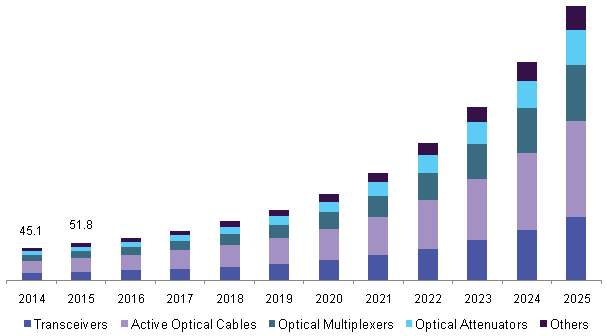
· In terms of products, the silicon photonics market is comprised of transceivers, active optical cables, optical multiplexers and optical attenuators, among others. The active optical cables segment accounts for an appreciable share in the market, as it is capable of transferring high data rates through silicon photonic products over a long distance. Moreover, they have substantial cost advantages over traditional optical modules, while also enabling streamlined installation for high-performance computing and storage applications. The optical multiplexers segment is expected to show fastest growth in the industry through 2025.
· Silicon photonics cover a range of application areas, including IT and telecom, healthcare and life sciences, defense and security, consumer electronics and commercial, among other such as media and advertising. The IT and telecommunications segment is expected to dominate over other segments in the market in the near future, on account of the rising penetration of smartphones and the impending emergence of the 5G-era across the world. Moreover, the segment is witnessing continuous advancements in technology, while existing fixed and mobile infrastructures are also witnessing numerous positive enhancements, thus driving the market further.
· Based on regional analysis, the silicon photonics market is expected to show major advances in North America and Asia Pacific regions in the coming years. The presence of a number of integrated silicon photonic manufacturing institutes in North America is expected to intensify research regarding photonic ICs to help minimize the cost of high-speed Internet access and boost efficiency of telecommunications networks. Organizations such as AIM Photonics have received sizeable grants in recent years from the US Government, thus providing encouragement for expansive research in this area.
· Asia Pacific is expected to show impressive growth in the coming years in the silicon photonics market. The region has seen rapid developments in the IT and telecom infrastructures in the past decade, and a strong growth for data centers, long haul and transport networks. Another factor amplifying the market output is the emergence of various smartphone companies, particularly from China, and their continued efforts to launch 5G-enabled smartphones, which has proved to be a boon for the industry players.
Recent Developments
· In March 2020, Intel integrated next-generation 1.6Tbps silicon photonics engines with the 12.8Tbps programmable Tofino 2 Ethernet switch that the company acquired from Barefoot Networks last year. The company claimed that co-packaged optics are a first in the industry, which help in reducing power consumption continued scalability of switch bandwidth. Moreover, the company had demonstrated its 400G silicon photonics transceiver in April 2019. These silicon photonics transceivers blend an integrated circuit with semiconductor lasers to provide blindingly-fast data transfers with Ethernet, InfiniBand and OmniPath protocols over longer distances than traditional copper networking cabling.
· In December 2019, Cisco announced Cisco Silicon One, a networking chip family designed to support multiple platform types and use cases. Additionally, the company also revealed the new Cisco 8000 Series of carrier-class routers based on the first member of the Silicon One family, as well as the Cisco IOS XR7 networking operating system for the 8000 Series. This was a part of the company’s new Internet for the Future” strategy. Cisco also reiterated its desire to get into the merchant optical transceiver business, which aligns with their acquisition of Acacia Communications earlier that year.
· In September 2019, II-VI acquired Finisar Corporation and formed the Compound Semiconductor and Photonic Solutions segments. The latter segment will leverage compound semiconductor technology platforms of II-VI for delivering differentiated subsystems and components for various end-use applications in major markets. Such developments are expected to drive market growth at an accelerated pace.
Discover more from Top Market Research Reports
Subscribe to get the latest posts sent to your email.
 Top Market Research Reports
Leave a comment