The global process chemicals for water treatment market size is expected to reach USD 9.9 million by 2025, according to a new report by Grand View Research, Inc., registering a CAGR of 5.6% during the forecast period. Growing need to replace or upgrade current treatment plants in developed nations has been fostering the growth of the market.
Mandatory approvals from pollution control boards as well as state government levels have further impelled major industry participants to adopt high-performance water-treatment machinery and equipment. These companies are expected to comply with stringent environmental regulations pertaining to appropriate treatment of wastewater. Water treatment chemicals are extensively used across applications to prevent microbial influenced corrosion and health hazards.
Geothermal power generation is likely to be the fastest growing application for process chemicals over the forecast period. Process chemicals are mainly used to address the problems in critical areas such as slime control for surface condensers and cooling tower fill, treatment of suspended solids in low-velocity heat exchangers, control of corrosion of steel components in system piping, concrete components in cooling tower, and steel condensate reinjection lines. Process choices are crucial to ensure reliability and operational efficiency in geothermal plants.
Defoamers are the most widely used process chemicals owing to their necessity in cooling towers. Cooling towers are highly susceptible to foaming as feed water is treated with several chemicals with surface active properties. Also, tower functions by drawing continuous flow of air from environment, which has several particulate and vapor contaminants. These can trigger bacterial and algal growth in systems, leading to surface fouling and foam formation. Moreover, cascade of water from top to bottom provides mechanical energy for foam formation, which can create operational inefficiency and downtime.
Asia Pacific emerged as the most significant market for process chemicals over the past few years. Rapid industrialization, coupled with growing awareness towards water pollution and treatment of wastewater, has been stimulating the growth of the market for process chemicals in the region. Additionally, government initiatives such as soft loans and subsidies for water treatment facilities has positively influenced the growth of the market.
Europe was a prominent revenue contributor in the market in 2016. The most widely used water treatment chemicals in the region include corrosion & scale inhibitors, coagulants & flocculants, pH boosters, softeners, defoamers, disinfectants, and biocides. The market is driven by stringent environmental regulations on wastewater management and high water-quality standards established for industrial applications.
To request a sample copy or view summary of this report, click the link below:
www.grandviewresearch.com/industry-analysis/water-treatment-process-chemicals-market
Further key findings from the report suggest:
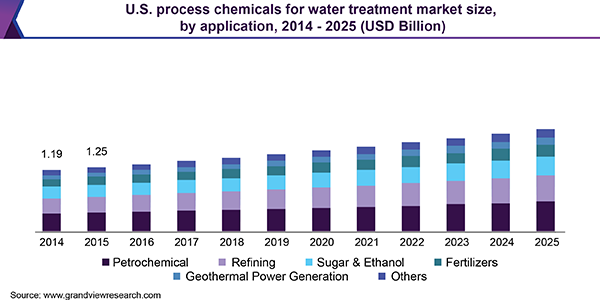
- The sugar & ethanol segment is likely to reach USD 2.17 billion by 2025, at a CAGR of 5.3% from 2017 to 2025
- In terms of volume, the petrochemicals segment is expected to expand at a CAGR of 4.9% over the forecast period
- In terms of volume, the geo-thermal power segment is poised to post a CAGR of 6.6% over the forecast period
- In terms of volume, Belgium process chemicals for water treatment market is anticipated to exceed 131 kilotons by 2025
- Countries in Asia Pacific, especially Singapore, Australia, South Korea India, Indonesia, Japan, and China, are projected to experience commendable growth during the forecast years.
Discover more from Top Market Research Reports
Subscribe to get the latest posts sent to your email.
 Top Market Research Reports
Leave a comment